Bottom line as of May 18, 2026: if you turn a paper into a visual abstract and publish it on X and LinkedIn, you can responsibly claim a 2-3x visibility lift based on real studies. What you cannot responsibly claim is that one social post will automatically multiply citations by a fixed amount across all fields.
Quick Answer: Do Visual Abstracts Increase Citations?
Directly: the best post-2025 randomized evidence does not show that a single X post increases long-term citations on its own.[1]
Indirectly: visual abstracts consistently improve the upstream metrics that make citations more likely later, such as impressions, article visits, and broader online attention. Multi-platform dissemination is also associated with higher later citation counts in a large 2025 analysis of 430,220 articles.[2]
So the most defensible claim is this: visual abstracts on X and LinkedIn increase the odds that your paper will be seen, clicked, discussed, and remembered. In some fields, that likely contributes to more citations over time, but the exact citation multiplier varies by discipline, audience, and campaign intensity.
1. Visual Abstracts Have the Clearest Causal Evidence
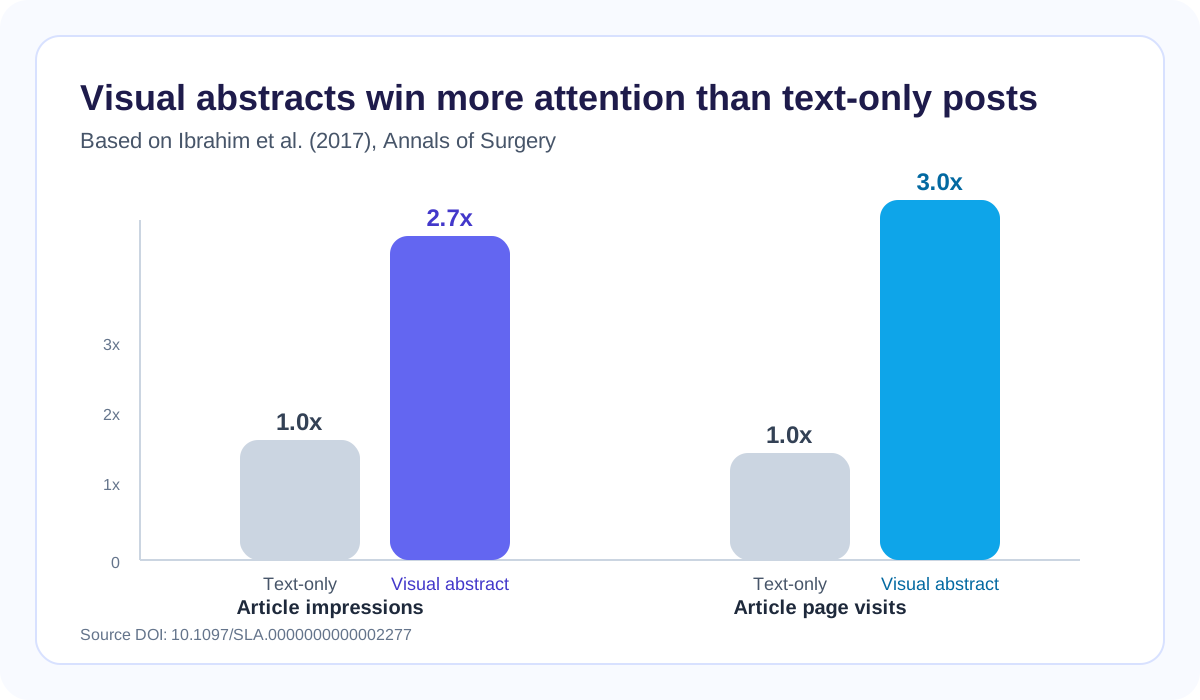
The foundational controlled evidence still comes from Andrew Ibrahim and colleagues in Annals of Surgery. Their 2017 prospective case-control crossover study compared standard text-link promotion against tweets that included a visual abstract. The visual abstract posts generated 2.7 times more impressions and 3.0 times more article page visits.[3]
A later prospective trial in European Urology also found that visual abstracts outperformed key figures for social reach, although click-through did not always improve in the same proportion.[4] That matters because it tells us visual abstracts are excellent at winning attention in the feed, but they still need a strong headline and clear value proposition to convert attention into reads.
2. The Newest 2025 Trial: Visibility Up, Citations Not Yet
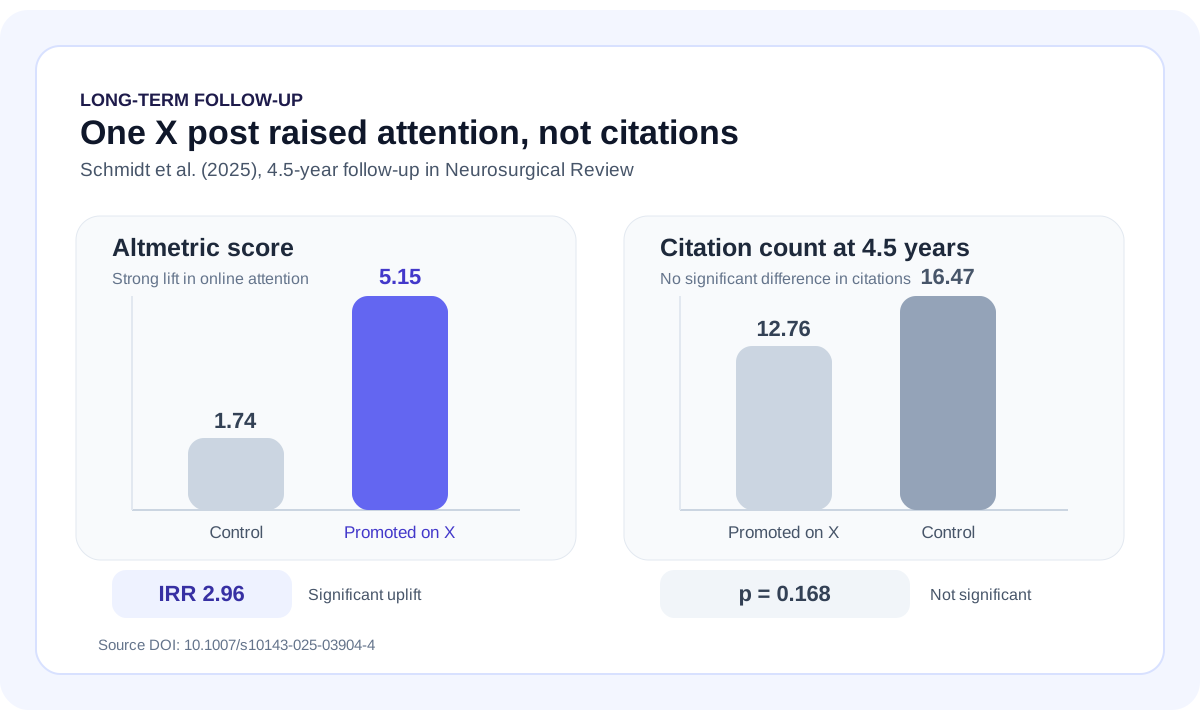
The most important newer paper is a long-term follow-up published on November 5, 2025 in Neurosurgical Review. It tracked 177 articles randomized to either a single X post or no social promotion and then checked outcomes again 4.5 years later.[1]
The result is the clearest reality check in this literature: promoted papers had much higher online attention, with Altmetric scores rising from 1.74 to 5.15 and an incidence rate ratio of 2.96. But citation counts were not significantly higher: 12.76 vs 16.47, p = 0.168.[1]
That does not mean social media is useless. It means one low-intensity post on one platform is usually not enough. If your content strategy stops at a single tweet, the best available 2025 evidence says you should expect more visibility, not guaranteed citation growth.
3. Why X Plus LinkedIn Makes More Sense Than X Alone
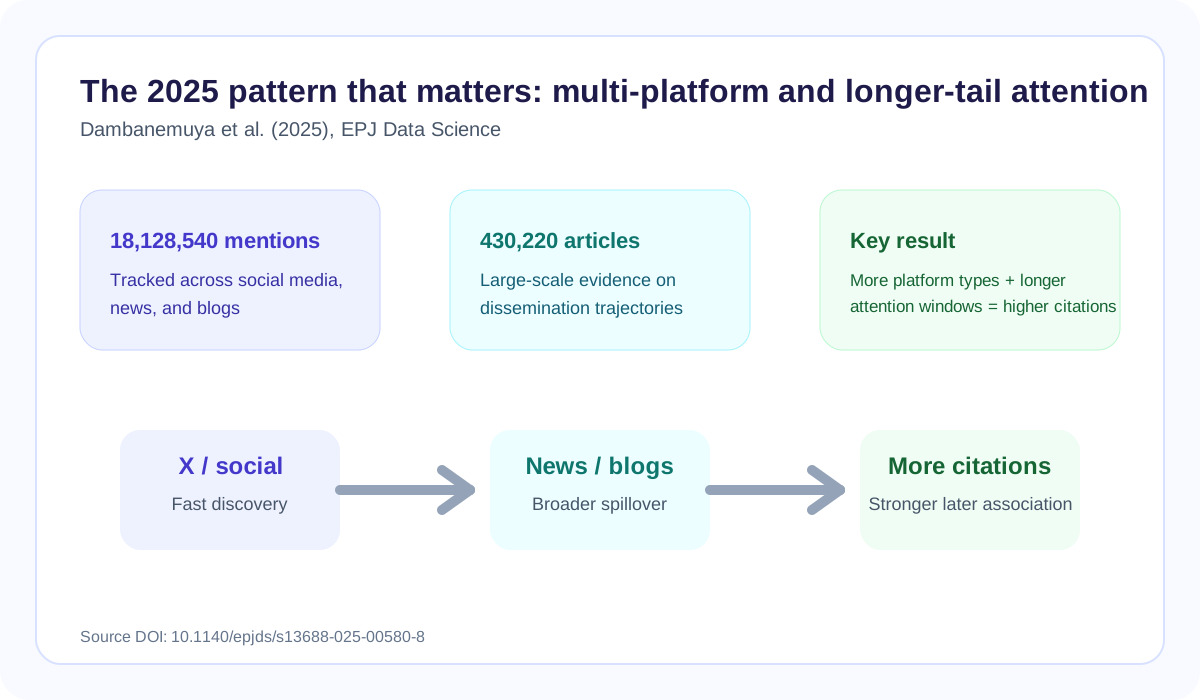
A large-scale 2025 study in EPJ Data Science analyzed 18,128,540 mentions of 430,220 research articles and found that two features mattered most: how many platform types an article reached and how long attention persisted.[2]
Their core finding was highly practical: articles with multiplatform trajectories and mentions spread over longer time windows were associated with higher later citation counts.[2] In plain English, a paper that appears in several places and keeps getting surfaced over a few days or weeks tends to do better than a paper that flares once and disappears.
This is the strongest current reason to use X and LinkedIn together. X is still efficient for real-time academic discovery and conference circulation. LinkedIn adds a second professional surface with a different audience: clinicians, industry researchers, administrators, science communicators, and policy-adjacent professionals who may never see your X thread.
4. What 2025+ Research Says About LinkedIn
LinkedIn-specific evidence is growing, but it is still earlier than the X literature. A 2025 bibliometric review mapped 1,273 peer-reviewed LinkedIn-related publications and described LinkedIn as the dominant professional social network in this research area, with a 102x increase in annual publication output from 2009 to 2023.[5]
A separate 2025 biomedical review explicitly listed X, LinkedIn, Mastodon, Threads, and Bluesky as the main platforms shaping research dissemination in 2024-2025.[6] In other words, LinkedIn is clearly part of the modern dissemination stack.
But here is the key truth for SEO and credibility: as of May 18, 2026, there is no strong LinkedIn-specific randomized trial showing a fixed citation multiplier for research papers. If you promise that LinkedIn alone will raise citations by a clean X times, you are overstating the evidence.
5. The Claim Researchers Can Safely Make
If you want a line that is both persuasive and evidence-based, this is the best version:
Visual abstracts shared on X and LinkedIn can increase the visibility of a paper by roughly 2-3x, and newer large-scale evidence suggests that papers discussed across multiple platforms over time are more likely to accumulate higher citation counts.
That statement is stronger than hype and safer than a universal promise. It aligns with what the literature can actually support: attention first, then distribution breadth, then possible citation upside.
6. Best Practice for Researchers in 2026
- Create one strong visual abstract with the main result, sample, and why it matters.
- Post it first on X for fast academic discovery and conference visibility.
- Repackage the same finding for LinkedIn as a carousel or image post with a clearer non-specialist hook.
- Ask co-authors, labs, and institutional accounts to repost within the next few days so the attention window lasts longer.
- Treat Altmetric and visits as leading indicators; treat citations as a delayed outcome.
Frequently Asked Questions
Q: Do visual abstracts on X increase research citations?
A: They clearly increase visibility and article visits. The newest 2025 randomized follow-up found that one X post increased Altmetric scores, but not long-term citations by itself.[1]
Q: Should researchers post papers on LinkedIn as well as X?
A: Yes. The strongest 2025 evidence favors multi-platform dissemination over one-platform bursts, and LinkedIn reaches a more professional audience than X alone.[2][5][6]
Q: Can I say social media increases citations by X times?
A: Not responsibly as a universal claim. What you can say is that visual abstracts often produce a 2-3x boost in attention, and broader multi-platform dissemination is associated with higher later citations.[2][3]
Q: What metric should I watch first?
A: Start with impressions, saves, link clicks, article visits, and Altmetric score. Citation counts move much more slowly.
References
- Schmidt AQ, Theiler S, Fariña Nuñez MT, et al. (2025). Does social media promotion influence citation counts? A long-term follow-up to a randomised trial in a general neurosurgical journal. Neurosurgical Review, 48, 759. https://doi.org/10.1007/s10143-025-03904-4
- Dambanemuya HK, Karimi F, Evans JA, Horvát EA. (2025). Timing and cross-platform presence shape the online dissemination of science. EPJ Data Science, 14, 46. https://doi.org/10.1140/epjds/s13688-025-00580-8
- Ibrahim AM, Lillemoe KD, Klingensmith ME, Dimick JB. (2017). Visual abstracts to disseminate research on social media. Annals of Surgery, 266(6), e46-e48. https://doi.org/10.1097/SLA.0000000000002277
- Klaassen Z, Vertosick E, Vickers AJ, et al. (2022). Optimal dissemination of scientific manuscripts via social media: A prospective trial comparing visual abstracts versus key figures in consecutive original manuscripts published in European Urology. European Urology, 82(6), 633-636. https://doi.org/10.1016/j.eururo.2022.01.041
- Khorshidi MS, Merigó JM, Beydoun G. (2025). Scientific Production on LinkedIn: A Bibliometric Review. Business and Professional Communication Quarterly. https://doi.org/10.1177/23294906251345075
- Shujath J. (2025). Beyond Traditional Publishing: Social Media as a Catalyst for Biomedical Research Dissemination and Collaboration. Journal of Interferon & Cytokine Research. https://doi.org/10.1089/jir.2025.0074
- Peng H, Teplitskiy M, Romero DM, Horvát EA. (2025). The gender gap in scholarly self-promotion on social media. Nature Communications, 16, 5552. https://doi.org/10.1038/s41467-025-60590-y