Short version: no serious committee is replacing papers with LinkedIn posts. But as of May 18, 2026, major funders and assessment systems explicitly ask for evidence of broader impacts, societal benefit, engagement, and contributions beyond a publication list. That is why social impact now matters for postdocs and assistant professors.
1. The File Has Changed: It Is No Longer Just Papers
The old mental model of academic evaluation was simple: publish strong papers, collect citations, and let the CV speak for itself. That model is incomplete now. In both funding and institutional assessment, evaluators increasingly want to know whether your work reaches beyond your narrow subfield.
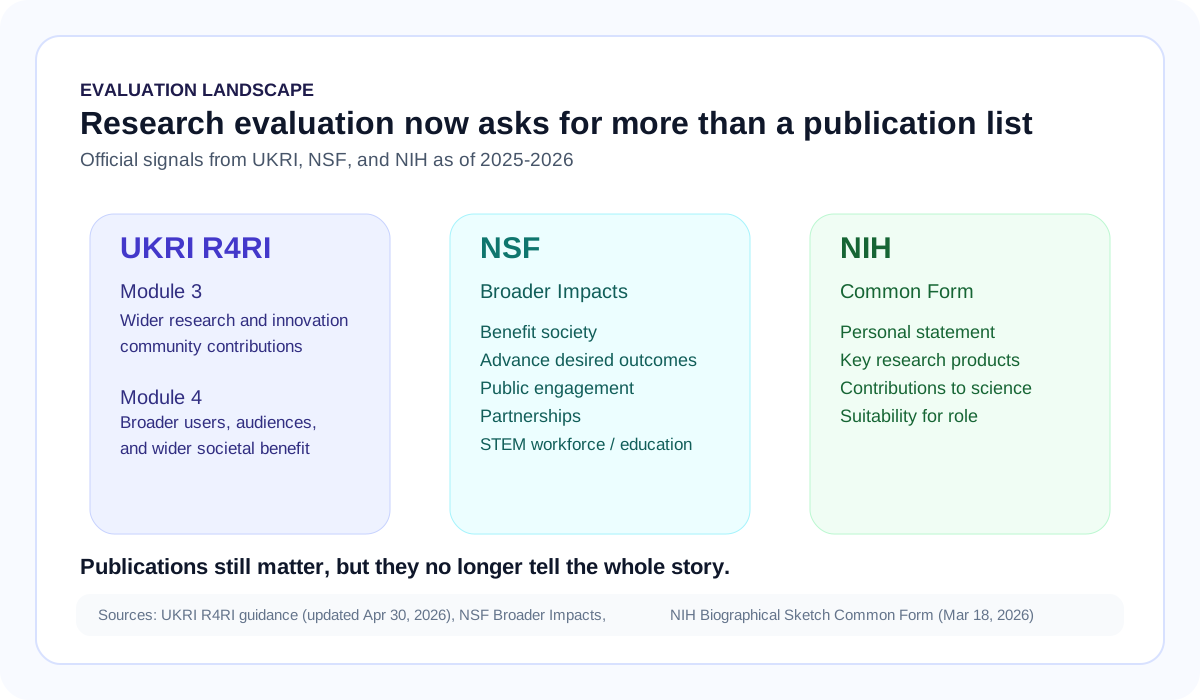
UKRI's current Résumé for Research and Innovation explicitly asks applicants to explain their contributions not only to new knowledge, but also to the wider research community and to broader societal benefit.[1] NSF proposal review still uses Broader Impacts as a core criterion, asking how the work will benefit society and advance desired societal outcomes.[2] And NIH's new Common Form system requires researchers to present a more narrative account of their contributions to science, not just a bare publication list.[3]
For postdocs and assistant professors, the practical takeaway is straightforward: if two candidates have similar publication records, the one who can show external relevance, public-facing communication, and broader usefulness has a clearer story.
2. What "Social Impact" Actually Means
Social impact does not mean becoming an influencer. In the language of funders and research assessment, it means showing that your research has value beyond academic citation exchange: public understanding, policy relevance, practitioner uptake, community benefit, clinical translation, or field-building work.
- For UKRI: evidence that you engaged broader users and audiences, contributed to policy development, or improved public understanding.[1]
- For NSF: a credible explanation of how the project benefits society, builds partnerships, strengthens STEM education, or increases public engagement.[2]
- For departments and institutions: a clearer case that your work is legible to students, funders, collaborators, policymakers, and non-academic stakeholders.
So when we say "build a personal brand," the academically serious version is this: make your expertise visible, interpretable, and usable outside your immediate citation network.
3. The Strongest Institutional Signal: REF 2029 Still Reserves 25% for Engagement and Impact
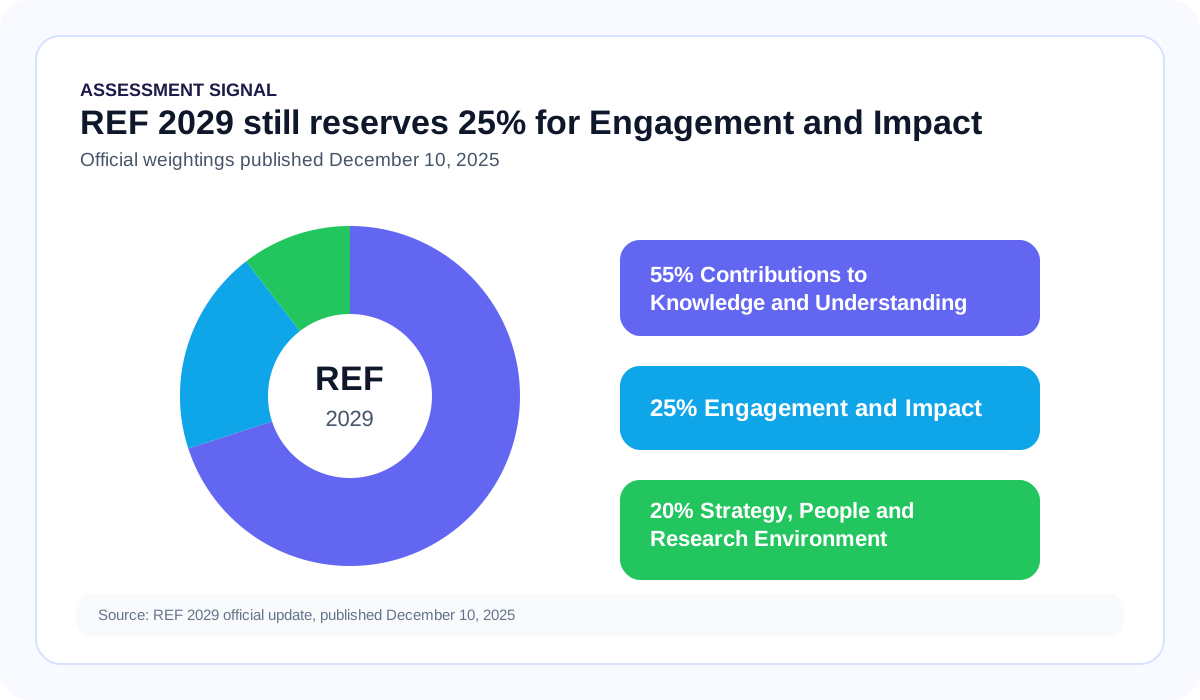
One of the clearest formal signals comes from the UK's REF 2029. In the official December 10, 2025 update, the framework set weightings of 55% for Contributions to Knowledge and Understanding, 20% for Strategy, People and Research Environment, and 25% for Engagement and Impact.[4]
That number matters. It means impact is not a decorative extra. At national assessment scale, a quarter of the framework is still reserved for real-world engagement and impact. If institutions are rewarded for impact, hiring committees have a strong incentive to favor candidates who can plausibly contribute to it.
4. Why LinkedIn Matters Even If No One Formally Scores LinkedIn
This is where many researchers get confused. Social impact is not the same thing as social media, but social media is one of the fastest ways to make impact visible. LinkedIn is especially useful because it is a professional discovery layer rather than a purely academic one.
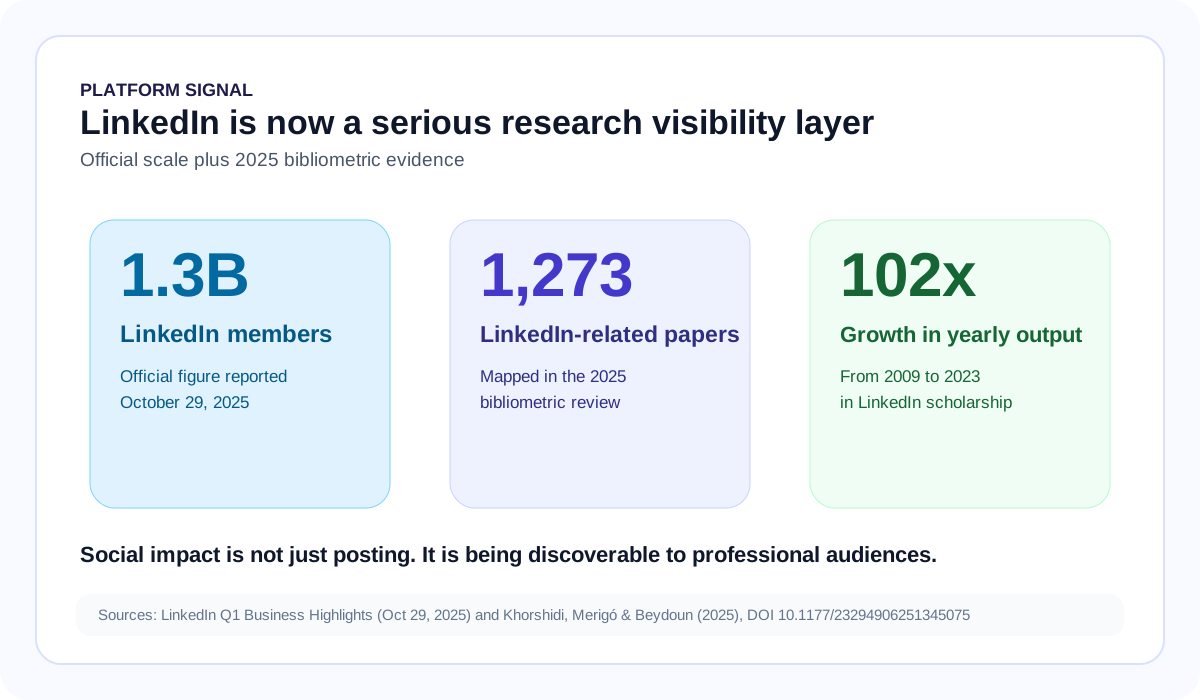
LinkedIn reported nearly 1.3 billion members in October 2025.[5] A 2025 bibliometric review also mapped1,273 peer-reviewed LinkedIn-related publications, with annual publication output growing 102x from 2009 to 2023.[6] That does not prove LinkedIn gets people jobs by itself. What it does show is that LinkedIn is now a large, mature professional visibility system that the research world can no longer dismiss as peripheral.
My inference from these sources: if your grant narrative or job talk emphasizes public relevance, but you have no discoverable public-facing footprint at all, your file is harder to interpret. A clear LinkedIn profile and a handful of high-signal research posts reduce that ambiguity.
5. Why This Hits Postdocs and Assistant Profs Hardest
Senior faculty can lean on reputation, networks, and long citation histories. Early-career scholars usually cannot. Postdocs and new assistant professors are evaluated under higher uncertainty: fewer papers, shorter track records, and less obvious independence.
In that context, social impact signals do three valuable things:
- They show that you can explain your work outside your narrow subfield.
- They show fundability, because many calls now expect broader benefit plans, user engagement, or dissemination thinking.
- They make your independence more legible, especially if your lab head has the bigger name.
This is why a visible, coherent research identity is no longer a vanity project. It is risk reduction for people evaluating your future potential.
6. What To Do If You Are Starting From Zero
- Rewrite your headline around your research problem, not just your job title.
- Add a short "About" section that explains what you study, why it matters, and who it helps.
- Turn each new paper into one visual abstract or carousel and one short plain-language post.
- Save evidence of uptake: invitations, reposts, policy mentions, practitioner responses, talks, and public engagement outcomes.
- Treat your online presence as support for your file, not a substitute for the file.
You do not need to post every day. For most early-career researchers, one strong research-facing post per paper is already enough to create a visible record of relevance.
Frequently Asked Questions
Q: Are faculty hiring committees really looking at social impact?
A: Increasingly, yes, though often indirectly. Committees may not score your LinkedIn page, but they are embedded in systems that increasingly reward broader impacts, engagement, and public relevance.[1][2][4]
Q: Does this mean publications matter less now?
A: No. Publications still anchor the case. The shift is that a strong file now often needs both scholarly credibility and a convincing story about wider benefit.
Q: Is LinkedIn the same as social impact?
A: No. LinkedIn is just one channel for making your work easier to find and understand. Real social impact is what happens when your research changes awareness, policy, practice, teaching, health, or public understanding.
Q: I'm a postdoc. What is the minimum viable version of this?
A: One clear profile, one plain-language summary of your research program, and one visual post per new paper is enough to start.
References
- UK Research and Innovation. (Updated April 30, 2026). Résumé for Research and Innovation (R4RI): guidance. https://www.ukri.org/apply-for-funding/develop-your-application/resume-for-research-and-innovation-r4ri-guidance/
- U.S. National Science Foundation. (Accessed May 18, 2026). Broader Impacts. https://www.nsf.gov/funding/learn/broader-impacts
- NIH Office of Extramural Research. (March 18, 2026). What Should I Know About the New Biographical Sketch Common Form? https://grants.nih.gov/news-events/nih-extramural-nexus-news/2026/03/what-should-i-know-about-the-new-biographical-sketch-common-form
- REF 2029. (December 10, 2025). REF 2029 publishes updates and resumes criteria setting following pause. https://2029.ref.ac.uk/news/ref-2029-publishes-updates-and-resumes-criteria-setting-following-pause/
- LinkedIn. (October 29, 2025). Q1 Business Highlights and Momentum. https://news.linkedin.com/2025/Q1-Business-Highlights
- Khorshidi MS, Merigó JM, Beydoun G. (2025). Scientific Production on LinkedIn: A Bibliometric Review. Business and Professional Communication Quarterly. https://doi.org/10.1177/23294906251345075